
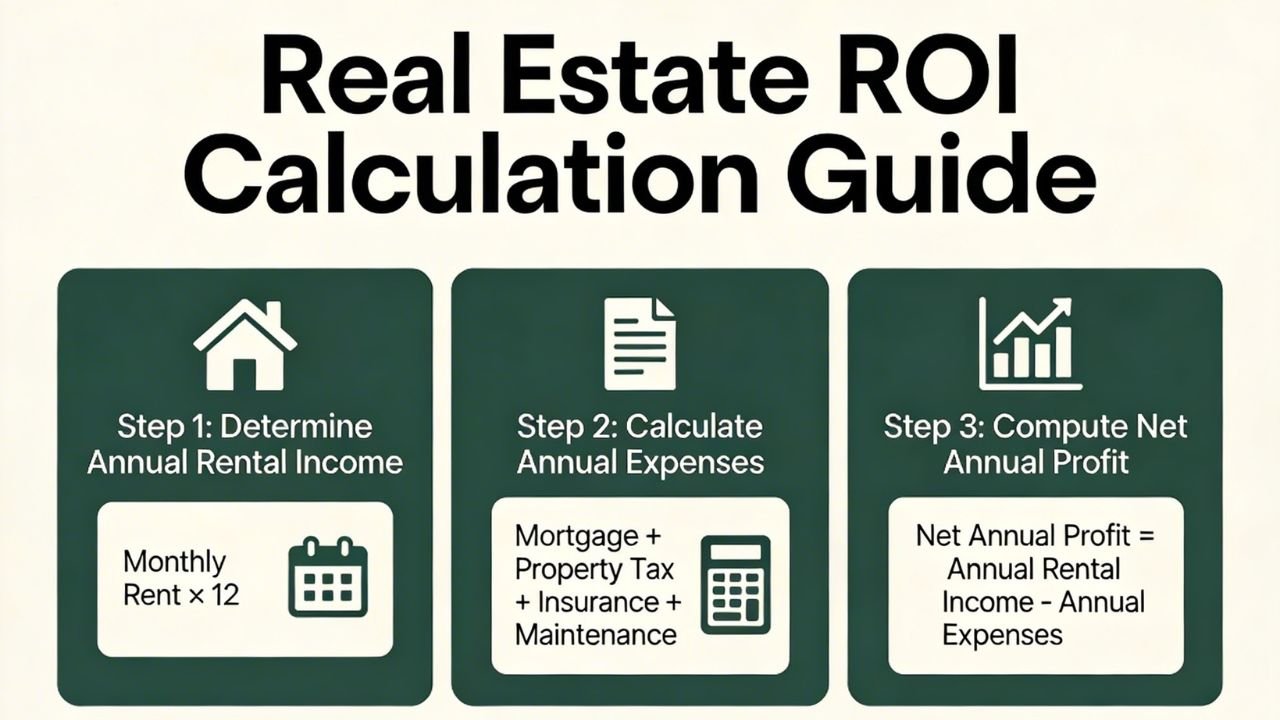
Investing in actual belongings may be quite worthwhile, but knowing your capability gains is essential before making any commitment. Return on Investment (ROI) is one of the most important metrics for actual belongings investors, because it measures the profitability of a property relative to the cash invested. Knowing a way to calculate ROI accurately enables consumers to make informed selections and maximize their returns.
What is ROI in Real Estate?
ROI in actual property is a percentage that indicates how much profit an investment generates as compared to its price. Essentially, it solves the question: “How lots am I earning from these belongings relative to what I paid?” A better ROI indicates amorer profitable investment.
The basic ROI formula is:
- ROI (%) = (Net Profit / Total Investment) × 100
Where:
- Net Profit = Income from the property – All expenses
- Total Investment = Purchase price + Closing costs + Renovation and other upfront expenses
Calculate Total Investment
The first step in calculating ROI is to decide the total amount you’ve invested in the assets. This consists of:
- Purchase Price: The price you paid for the property.
- Closing Costs: Legal fees, registration, agent charges, and other transaction-related charges.
- Renovation/Repairs: Any cash spent on improving or repairing the assets earlier than renting or promoting.

For example, if an asset prices $one hundred and 50 000, final expenses are $5 000, and maintenance costs are $10,000, your total funding is:
- 150,000 + 5,000 + 10,000 = $165,000
Determine Net Profit
Next, calculate the net benefit from the property. For rental houses, this consists of rental profits minus ongoing prices which include:
- Property taxes
- Maintenance and repairs
- Insurance
- Property control charges
- Utilities (if paid by the owner)
For assets generating $18,000 in annual rent and $5,000 in annual expenses, the net earnings are:
- 18,000 – 5,000 = $13,000
If you propose to promote the property, net profit would be the selling rate minus the whole investment, inclusive of last costs and commissions.
Apply the ROI Formula
Once you have got the overall funding and net income, you may calculate ROI:
- ROI (%) = (Net Profit / Total Investment) × one hundred
Using the rental instance:
- ROI = (13,000 ÷ 165,000) × a hundred ≈ 7.88%
In this manner, the assets generate a return of approximately 7.88% yearly aonthe cash invested.
Consider Cash-on-Cash ROI
For traders who finance residences through loans, cash-on-cash ROI is frequently more relevant. It calculates the return on the actual coins invested (down charge initial prices), apart from the financed portion:
- Cash-on-Cash ROI (%) = (Annual Cash Flow / Cash Invested) × one hundred
This allows traders to understand how efficiently their very own cash is running, in particular whilst leveraging mortgages.
Factors That Affect ROI
ROI in real estate can fluctuate due to several factors:
- Property location and market demand
- Maintenance and repair costs
- Rental occupancy rates
- Market appreciation or depreciation
- Interest rates on loans
By reading these elements and calculating ROI appropriately, traders can evaluate a couple of properties and pick out the most profitable options.
Conclusion
Calculating ROI is an important step for every person investing in actual property. By know-how, total investment, internet income, and cash-on-coins returns, buyers could make informed choices, limit risks, and maximize profits. Whether buying condo houses or flipping houses, ROI offers a clear picture of a property’s monetary performance, helping you reap lengthy-time period achievement in the real estate market.