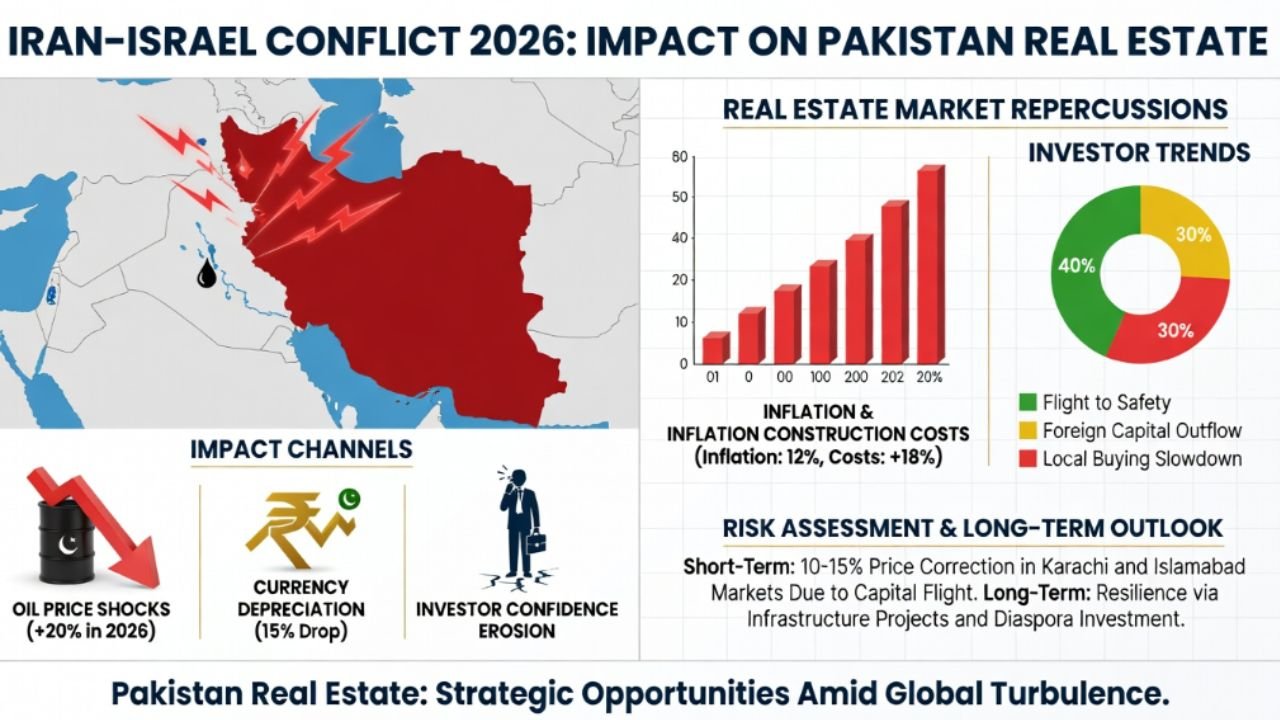
The ongoing war between Iran and Israel in 2026 has created fundamental geopolitical and monetary uncertainty across the Middle East and international markets. Although the conflict is geographically distant from Pakistan, its indirect consequences are felt strongly in the Pakistani economic system — especially in real estate.
The state of Pakistan’s real estate market is extremely sensitive to oil tariffs, remittances, inflation, a nd investor confidence. As a result, any major conflict nearby can reshape investment trajectories, construction costs, and average market stability.

The Global Impact of Conflict
The conflict between Iran and Israel has disrupted international power lines, especially around the Strait of Hormuz, a major route for oil and gasoline shipments, leading to:
- Rising international oil costs
- Shipping and insurance costs have gone up.
- Comparison of inflation pressures in countries
- Volatility in the financial markets
Reports indicate that international alternative energy supply chains are being imposed due to ongoing tensions that are simultaneously affecting emerging economies such as Pakistan.
Direct Economic Impact on Pakistan
Pakistan is particularly vulnerable to geopolitical shocks in the Middle East because:
- A large portion of its oil is imported
- Millions of overseas Pakistanis work in Gulf countries
- Remittances form a major part of the national income
Research indicates that rising oil prices increase construction costs and reduce real estate affordability, while uncertainty can also affect remittance inflows.
Impact on the Real Estate Market in Pakistan
(a) Rising Construction Costs
Higher global oil prices lead to increased prices of:
- Cement
- Steel
- Transportation
- Labour costs
This directly slows down new development projects and increases property prices.
(b) Investor Caution and Market Slowdown
During geopolitical uncertainty, investors often:
- Delay buying decisions
- Prefer safer assets like gold or foreign currency
- Reduce speculative property investments
This results in temporary slowdowns in real estate transactions.
(c) Long-Term Stability of Property Market
Despite short-term uncertainty, Pakistan’s real estate market has historically shown resilience. Demand for housing remains strong due to:
- Population growth
- Urban expansion
- Housing shortages in major cities
Experts suggest that while short-term volatility exists, long-term property value trends remain positive.
Role of Remittances in Supporting Real Estate
One of the strongest stabilizing factors for Pakistan’s property market is overseas remittances.
If geopolitical tensions increase:
- Short-term remittance flow may become unstable
- However, long-term dependency on Gulf employment continues
- Overseas Pakistanis still invest heavily in property
This keeps demand alive in major cities like Lahore, Karachi, and Islamabad.
Investment Behavior in 2026
In 2026, investors are expected to follow three main trends:
(a) Shift Toward Safe Projects
Investors prefer trusted housing societies with strong legal status and infrastructure.
(b) Focus on Developed Areas
Ready-to-move properties and possession plots gain more attention than file-based investments.
(c) Long-Term Holding Strategy
Due to uncertainty, short-term flipping reduces while long-term holding increases.
Opportunities in Real Estate Despite Conflict
Even in uncertain conditions, opportunities exist:
- Affordable plots in developing societies
- Commercial properties in growing urban areas
- Rental income properties due to housing demand
- Long-term appreciation in well-developed schemes
Geopolitical crises often create buying opportunities for long-term investors who can tolerate short-term fluctuations.
Key Risks Investors Should Watch
Investors should remain cautious about:
- Rising inflation affecting affordability
- Currency depreciation
- Delays in construction due to cost pressure
- Short-term market instability
Proper due diligence and risk management are essential.
Final Thoughts
The 2026 Iran-Israel war is reshaping global monetary transactions and impacting Pakistan’s real estate sector in the roundabout. While immediate-term impacts include inflation, improved construction rates, and prudent financing behavior, the long-term outlook remains strong for strong housing demand and concrete development.
The most important product prospects for buyers in 2026 are clear: awareness of stable and well-developed features, avoidance of design, and prioritizing long-term value over short-term benefits.